Category: Featured

Featured posts show up in the default sidebar.

  • Ford Models Review: What to Know About Ford Modeling Agency [2023]

    Ford Models Review: What to Know About Ford Modeling Agency [2023]

    When it comes to the modeling industry, Ford Models is one of the most prominent and respected names. With over 50 years of experience, Ford Models has been the launching pad for countless superstars in the fashion world and beyond. 

    This article delves into the world of Ford Modeling Agency, from its humble beginnings to its rise to prominence. We’ll explore the agency’s history, philosophy, and its current models and establishments. Whether you’re curious about the agency’s inner workings, are aspiring to be a model, or simply want to learn more about the exciting world of modeling agencies, this article is your comprehensive guide to Ford Models. 

    Who Runs Ford Models?

    In 2020, Ford Models was acquired by Ford Models Brazil, with Decio Restelli Ribiero appointed as the new CEO. He is now responsible for overseeing both Ford Models and Ford Models Brazil.

    Ready to Streamline Your Casting, Booking, and Payroll Process?

    Ford Modeling Agency Review

    Ford models image

    About Ford Models

    Ford  Models is at the forefront of the fashion industry, representing talent worldwide and merging culture and creativity. With its headquarters in New York City and offices in Paris, Los Angeles, Chicago, and Miami, Ford Models continues to innovate and influence both the modeling and fashion industries.

    History

    Founded in 1946 by Eileen and Jerry Ford, Ford Models revolutionized the modeling industry by introducing a new type of global business based on beauty. Starting in their New York City home, Eileen and Jerry created a company and brand that shaped the modeling industry. 

    In 1980, Ford Models began the Ford Supermodel of the World Contest, which drew in more than 60,000 aspiring models from all over the world. This contest continued to be held as the VMan Ford Model Search with the support of the Visionaire publications. 

    In the 2000s, the company expanded by forming Ford Artists, which aimed to represent people who work in the hair, makeup, and wardrobe industries. It also began its social media platform, including the Ford Models Blog, Twitter, Facebook, and YouTube. Additionally, Ford Models established an imprint of Random House books, which created a series of teen novels that attempted to present a glamorous picture of their work with the agency. 

    In 2011, Chairman Guerman Aliev diversified the company further by introducing the Ford Models Art Gallery. Since then, Ford Models has opened two locations in Brazil in San Paolo and Rio de Janeiro.

    Locations

    Ford Models has six modeling locations, four in the United States and the other two in Paris and Brazil. 

    New York 

    New York is the capital and home of Ford Models and has produced some of the most iconic talents in the world, including the world’s first supermodel, Janet Dickinson. Ford Models New York has collaborated with brands such as Versace, Calvin Klein, Saint Laurent, Louis Vuitton, and more. 

    Models currently signed by Ford Models New York include Kate Li, Leslie Sidora, Barbara Palvin, Ali Tate, Channing Tatum, Kelly Gale, and Tyson Ritter. 

    Contact Information: 

    11 East 26th Street, 14th Floor, New York, NY 10010

    (212) 219-6500

    ny@fordmodels.com

    Paris 

    Ford Models Paris branch opened in 1991 and has worked with various brands including Gucci, Burberry, Ferragamo, and Harper’s Bazaar. Their most recent booking was with Louis Vuitton for a pre-fall campaign this year with Sora Choi and Takfarnes Bengana. 

    Ford Models Paris represents talents Sora Choi, Issa Naciri, Amar Akway, Estelle Chen, Amelia Gray Hamlin, and more. 

    Contact Information: 

    278 Boulevard Saint-Germain, 75007 Paris, France

    (+33) 144180808

    info@fordmodels.fr

    Los Angeles

    The Los Angeles location of the Ford Model represents the following models Allie Redmond, Melanie Colic, Raquel Bieri, and more. Their talent has been featured on the cover of Perfect Magazine, Self-Portrait, Arena Homme+, Vogue, Marc Jacobs, and more. 

    Contact Information: 

    9000 W Sunset Boulevard, Suite 720, West Hollywood, CA 90069

    (310) 276-8100

    la@fordmodels.com

    Chicago 

    The Ford Models Chicago branch is where the talent Abbe, Dana Taylor, Eleanor Burke, and Abigail Olin call home. Ford Models Chicago has worked with major brands such as DKNY, L’Officiel, Yves Saint Laurent, and Mode Magazine. Ford Chicago is also home to the Ford Artists division. 

    Contact Information: 

    850 West Jackson Blvd, Suite 410, Chicago, IL 60607

    (312) 243-9400

    chicago@fordmodels.com

    (312) 646-7330

    artists@fordmodels.com

    Miami 

    Ford Models Miami was recently revived in 2021 and is bringing the heat with the new faces Abby Garret, Chloe Yu, Jasmin Johnson, and Livia Rangel. In the short time their Miami office has been open, Ford Models Miami has collaborated with Elle Magazine, Calvin Klein, Harper’s Bazaar, Adidas, and others.

    Contact Information: 

    225 NE 34th St, Suite 205, Miami, FL 33137

    (305) 534-7200

    miami@fordmodels.com

    Brazil 

    Brazil is their newest location, run by the current CEO of Ford Models, Decio Restelli Ribiero, and has three departments: women, men, and curves. The Brazil location also represents actors, DJs, and musicians. Talent includes Nanda Lisboa, Eli Wasa, Daniel Aguilar, and Iza Moreira. 

    Contact Information: 

    Av. Magalhães de Castro 4800, Capital Building, Suite 173, São Paulo, SP 05676-120

    +55 11 3506 6101

    Famous Ford Models

    Famous Ford Models

    With Ford Models being one of the longest modeling agencies in the industry, we’ve seen some of the most iconic talent grace the cover of magazines, ads, commercials, and more. Here are some of the most famous faces currently being represented by Ford Models right now: 

    • Ali Tate
    • Beverly Peele
    • Barbara Palvin
    • Estelle Chen 
    • Christina Kruse
    • Kirsten Owen
    • Sigrid Agren
    • David Gandy
    • Fran Summers
    • Daniel Di Tomasso
    • Sora Choi

    Ford Models also fostered the careers of these supermodels and renowned actresses: 

    • Brooke Shields
    • Janet Dickinson
    • Naomi Campbell
    • Beverly Johnson
    • Elle MacPherson
    • Jane Fonda
    • Courtney Cox

    Other Ford Artists

    hair and makeup

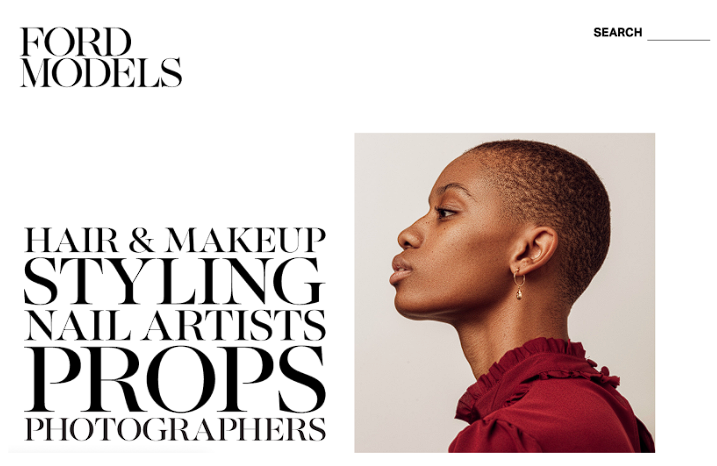
    Ford also signs and manages stylists and artists in their Ford Artists division. They represent hair and makeup artists, women, men, and kids stylists, nail artists, props managers, and photographers. 

    More About Ford Models

    Gucci model

    Ford Model Requirements

    Ford Models does not list their requirements publicly on their website, but they do share this: 

    FORD’s Tips to Getting Scouted:

    Professional model scouts are looking for something different than you might expect. We don’t want to see you in your fanciest outfit with lots of makeup on. We are looking for you at your most natural.

    • Have a clean face with absolutely no makeup.
    • Pull your hair back.
    • Wear a form fitting outfit like skinny jeans and a tank top. We need to see the shape of your body.

    How Much Do Ford Models Make?

    Like other modeling agencies, a model’s pay varies depending on the project and its duration. Some models may take on multiple small projects at once or work on a major project for a longer duration. 

    How to Become a Ford Model

    Ford encourages individuals to attend their open calls at their Chicago location or submit an application via their online form. 

    The modeling agency also warns of scammers posing as Ford Models. Ford Models does not ask their applicants to pay money to attend a casting call or to send explicit photos.

    Every Ford Model representative reaches out to talent with an email that ends in “fordmodels.com,” but always make sure you verify their identity. If you’re unsure about a representative, always call them directly.

    Ford Model Resources

    Ford model

    Website

    Social Media

    The Bottom Line on Ford Models

    From classic supermodels like Naomi Campbell and Janet Dickinson to modern-day supermodels like Sigrid Agren and Beverly Peele, Ford Models Agency has been at the forefront of the modeling business for decades. Known for their impressive list of models, having them be part of your next project would be a dream. 

    No matter what project you’re working on, LÜK is ready to make your next project simple and seamless. Our producer tool collection makes organizing castings, bookings, and contractor payroll…dare we say easy? 

    You can cast and book talent from multiple agencies right on the platform and then our 1099 payroll feature streamlines your accounting further by putting all your 1099 contractors on one invoice. 

    No more worrying about payroll taxes, tracking tax records, or subtracting taxes from employee wages. We’re your accounting department, personal booking specialist, and industry expert…all on one platform! 

    Ready to experience the beauty of perfect production?

  • What Is a Production Coordinator? 15+ Tips for Your Production Coordinator Career [2023]

    What Is a Production Coordinator? 15+ Tips for Your Production Coordinator Career [2023]

    There’s so much brain and manpower that goes into producing a successful shoot. From casting directors to crew members to caterers, photo and video shoots are a collaborative effort from beginning to end. 

    In a producer’s perfect world, there’s an expert at the helm of each role so everyone can focus on doing what they do best. In the realm of production, there are a handful of jobs that support one another during each phase of the work. 

    We’re here to focus on one: the production coordinator. With over 60,000 production coordinators in the US alone, these professionals are a huge part of keeping the entertainment industry running smoothly. 

    Production Coordinator Job Description

    A production coordinator is responsible for organizing and overseeing many administrative and logistical elements of production management. The specific responsibilities of a production coordinator depend on the size and demands of the project at hand, but their main goal is to support the production team and facilitate effective communication. 

    Some typical duties of production coordinators include:

    • Distributing call sheets
    • Guiding the physical production team during set up and breakdown
    • Arranging meals, transportation, equipment rentals, and permits
    • Securing any entertainment insurance required for the shoot
    • Making sure the project stays on budget and on schedule
    • Managing 1099 payroll to ensure independent contractors and vendors are paid on time
    • Being available to the producer for any lingering to-dos

    People in this role must be quick on their feet under pressure and have a knack for effective communication. 

    Skills Needed to Be a Successful Production Coordinator

    Each production coordinator has their own particular flow and style for how to get the job done. That said, there are a few skills every one of them should have to be effective in the role.

    • Organization and attention to detail
    • Time management
    • Effective communication 
    • Adaptability
    • Ability to perform and solve problems under pressure
    • Technical familiarity and proficiency. While it’s not necessary for a production coordinator to be an expert in gear, they should have a general understanding of the tools of the trade.
    • Knowledge of production processes
    • Professionalism 

    Make Your Next Production Simple & Successful 

    Payroll, casting, booking, worker’s comp…we have it all covered.

    What Is a Production Coordinator Responsible For?

    crew member

    Overall, the production coordinator is tasked with ensuring the ideal execution of each step of the production, working closely with the production manager and each other department to keep everything running smoothly. 

    Let’s go over what a production coordinator’s role looks like during the different stages of the production process. 

    Pre-Production

    Before a shoot, a production coordinator will assist in preparing teams for the days ahead. Their to-do list may require support in:

    • Securing production insurance
    • Assisting with casting calls and booking talent
    • Managing contractor payroll process
    • Creating call sheets
    • Building a crew
    • Determining location requirements
    • Securing permits and equipment
    • Arranging meals and transportation for the cast and crew

    The particulars will depend on the scope of the project, but there is a great deal that goes into getting a shoot ready to roll before day one. 

    Looking for help with the casting and booking process? LÜK’s here to help. LÜK Network combines talent submissions from every agency you know and love with a suite of producer tools that streamlines every part of the booking process. 

    Whether it’s searching for specific talent, setting up castings, sharing role-specific details, or processing payment and taxes, LÜK handles it for you. 

    During Production

    producer

    During the shoot itself, the production coordinator is tasked with putting out fires and keeping the ship afloat. This might include:

    • Acting as point-of-contact for crew members
    • Tellings PAs where to set up and how to support the flow of the day
    • Distribute, collect, and organize the relevant paperwork
    • Communicate any changes, needs, or problems to relevant teams as they arise

    Post-Production

    post-production

    After shooting wraps, the production coordinator is tasked with making sure all the loose ends of the project are tied up. This step is crucial to be sure folks are paid, paperwork is filed, and budgets are adhered to. Their post-production responsibilities likely involve:

    • Being sure all folks are onboarded to the payroll system of choice so they are being paid promptly
    • All receipts and expenses are recorded and accounted for
    • All gear is accounted for and returned

    Looking for help with this step too? LÜK Network has your back. Our full-coverage offering provides a single point of contact for all your contractor payroll needs. By choosing LÜK, you can streamline your billing and compliance, ensuring that your talent is paid accurately and on time–every time.

    Production Coordinator Salary

    The salary of a production coordinator is dependent on things such as the city they are working in, the size of the production they are involved in, their level of experience, and their specific responsibilities.

    In the United States, the salary for production coordinators can be anywhere from $30,000 to $80,000 a year with the average annual salary being around $50,000. On estimate, hourly rates for this role can range from $16 to $32. 

    How to Become a Production Coordinator

    Like any other job in the industry, becoming a production coordinator typically takes a balanced combination of education, relevant working experience, and extensive networking within the industry. 

    1. Schooling

    There isn’t a specific educational requirement for becoming a production coordinator, as folks of many different schooling backgrounds can get the job done well. 

    However, pursuing a degree or completing relevant courses may give individuals foundational skills that make them attractive, qualified candidates for the job. Pursuing a degree in film, television production, communications, or a related field helps set up the relevant skills and knowledge this job requires. 

    2. Interning & Work Experience

    Building actual experience is really the best way to become qualified for any role in the production industry. Volunteering or interning on film or television productions can provide opportunities to network with professionals working in the industry as well as gain hands-on experience in the job at hand. Offer your assistance, express your eagerness to learn, and be proactive in building relationships with the production team. 

    These roles can provide useful exposure to the production process and first-hand experience working with professionals in whichever area of the industry they’re interested in.

    3. Entry-Level Roles

    Production coordinators often begin their paid careers as production assistants, also known as “PAs”. Working as a PA empowers folks to learn the ropes of production, gain practical experience, and demonstrate a dedication to and the ability to handle set responsibilities. 

    PAs work hand in hand with production coordinators, which is the best way to learn the skills they’d like to emulate. Developing the relevant skills is the most important piece of the puzzle. Honing the skills and foundational knowledge that is specific to production coordination is just essential. 

    In any entry-level role, a focus on developing organizational skills, communication skills, time management, and attention to detail is the best place to begin.

    4. Networking

    Networking is key for building connections and opportunities within the production industry or any industry for that matter. One strategy for networking effectively is to attend industry events like:

    • Film festivals
    • Conferences
    • Workshops

    Attend these types of events when they pop up to actively engage with other professionals and participate in the community. This strategy can help you learn about the industry, build relationships, and find work or internship opportunities. 

    5. Join Industry Organizations and Associations

    Become a member of industry organizations and associations such as the Producers Guild of America (PGA), Directors Guild of America (DGA), or local film commissions. 

    These groups are often hosting networking events, posting job boards, and providing resources for professionals in the industry. Participate in these organizations to meet folks who are doing what you’d like to be doing—people love sharing their experiences and helping newcomers!

    6. Reach Out for Informational Interviews  

    Find production coordinators or professionals whose careers you admire and reach out for a time to chat and pick their brains. Prepare thoughtful questions, express your interest in their work, and seek advice on how to get started in a meaningful way. 

    Informational interviews can lead to finding valuable insight, potential mentors, or even job opportunities down the road.

    7. Utilize Online Resources

    Social media platforms like LinkedIn, Twitter, and industry-specific forums can be powerful networking tools across the board. 

    Create a professional profile highlighting your experience, skills, and goals. Connect with the professionals in your specific industry, join relevant groups, and actively participate in discussions. Share industry-related news, insights, or your own work to establish your presence and engage with others. Simply put, use these tools to build your personal brand, get involved, and meet people who you could collaborate with in the future.

    8. Attend Local Industry Events or Meetups

    Keep an ear out for local industry mixers, meetups, or networking events specifically tailored for professionals in the production field. 

    These events offer an informal, comfortable setting to connect with working professionals, make new contacts therein, and exchange passions, ideas, and goals. Actively involve yourself in conversations, ask pointed questions, and follow up with the folks you meet and have a connection with! 

    9. Build a Team and Get Started

    Collaborate with folks in other roles on independent projects in your chosen field. Working with peers who are also just getting started can foster lasting relationships and open doors to future opportunities for each of you. 

    As you gain experience in real life circumstances and prove your skills, you may be recommended for production coordinator roles or introduced to industry professionals as you build your resume.

    Most of all, keep in mind that networking is not simply about seeking opportunities for yourself, but also about building genuine connections and offering support to others who are building careers in the industry. 

    Approach networking with an optimistic and authentic mindset, and be proactive in maintaining the connections you make. Building a strong network takes time and effort, but it can greatly enhance your chances of becoming a production coordinator or working any job for that matter.

    10. Continuously Improve Technical Skills

    Stay updated with the latest software, tools, and technologies used in production coordination. Familiarize yourself with scheduling software, spreadsheets, and other industry-specific applications. This is a great way to maintain a competitive edge as you build your skills and cultivate your specialties in the field.

    One of the best tools for production coordination? LÜK! LÜK Network provides entertainment payroll services tailored to the specific needs of producers. The user-friendly platform makes tracking and managing the payroll for independent contractors in your cast and crew easy. We ensure freelancers are appropriately classified, workers’ compensation and payroll taxes are handled, and talent from multiple casting agencies is paid through one invoice.
    We know it sounds too good to be true, so book your demo here to see how it works!

    11. Develop Soft Skills

    Strengthen your organizational skills to manage multiple tasks, deadlines, and resources efficiently. Use productivity tools, calendars, or project management software to stay organized and prioritize tasks effectively. 

    Communication is a key aspect of being an effective production coordinator. Work on improving your verbal and written communication skills whenever you can! Practice clear and concise communication, active listening, and convey instructions and information effectively to whoever you’re interacting with. 

    Production coordinators also consistently encounter unexpected challenges and changes on the job. Practice problem-solving techniques and develop the ability to make decisions under pressure when you can. This is a bit of an abstract skill, but a great one to keep in mind as you build your professional toolbelt.

    12. Foster Strong Relationships and Teamwork

    Cultivate positive working relationships with crew members, departments, and any other teammates involved in the production. Collaborate effectively, foster a sense of camaraderie, and maintain open, smooth lines of communication. 

    Being approachable, kind, and supportive will make everyone’s jobs easier and people will remember you for it.

    13. Seek Feedback and Learn from Your Experiences

    Actively seek feedback from colleagues, supervisors, and industry professionals during and after a shoot. Reflect on your performance and be mindful to identify any areas for potential improvement. 

    By doing so, you can learn from past experiences and apply hard lessons learned to your future projects. Be sure to embrace a growth mindset and be open to learning and evolving in your role as you go.

    14. Be Calm Under Pressure

    Production environments are oftentimes fast-paced and high-pressure. Take time to develop strategies to manage stress effectively and maintain a calm and composed outlook and attitude. This will enable you to make clear decisions and lead your team efficiently, even in challenging situations. And again, people will appreciate and remember you for it!

    15. Stay Organized With Documentation and Record-Keeping

    Maintain accurate and up-to-date production documentation, such as call sheets, budgets, and schedules. Develop efficient systems for record-keeping and archiving. This will help you access information quickly, track progress, and ensure compliance with legal and administrative requirements. 

    Improve Production Coordination with LÜK 

    Great production coordination involves a lot of moving parts. The best method for smooth sailing is to build a trustworthy, awesome team and then simply delegate, delegate, delegate! It’s all about the quality of the folks you work with and of the tools at your disposal. 

    Having a production partner like LÜK Network for payroll, insurance, and casting is proven to provide a valuable edge on the integrity and efficiency of your workflow. 

    No matter your role in production, we’d be thrilled to meet and chat and show you how we can supercharge your shoot with our support. It’s our thing.